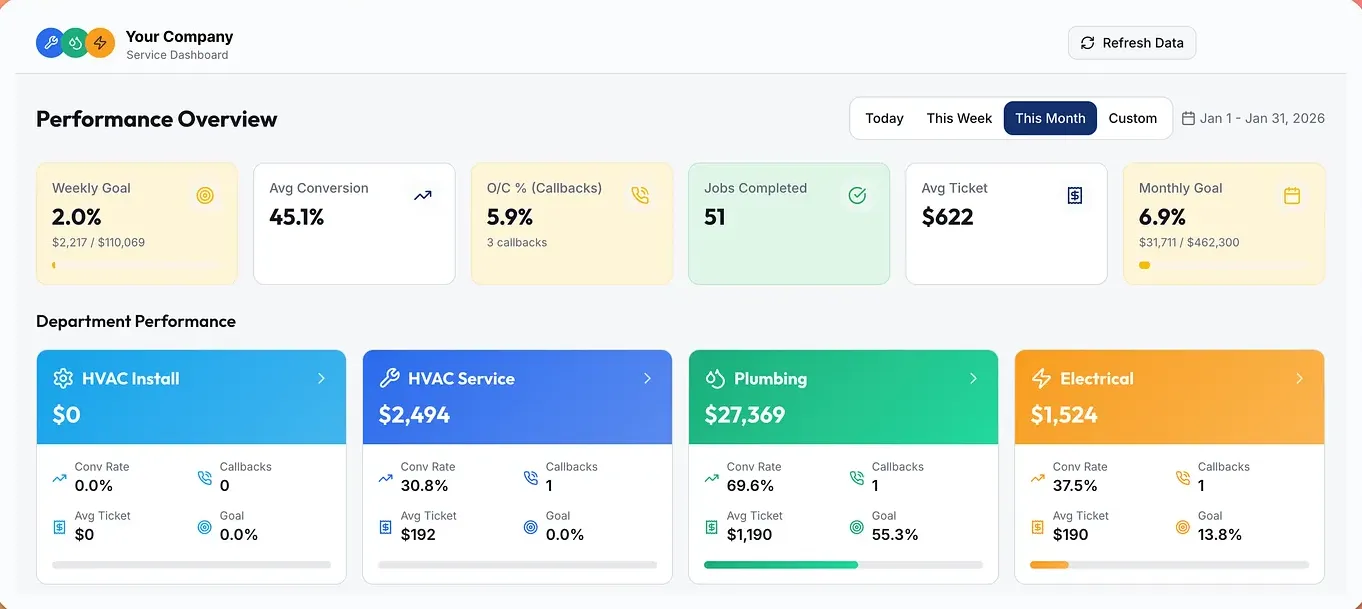
You run your business on a feeling and a stack of reports that show up too late. Sales might be up. A few invoices are probably overdue. Some jobs make money and some quietly lose it, but you find out at tax time. Small business dashboards fix that. One screen shows profit by job, sales, unpaid and overdue invoices, and your pipeline. It rebuilds overnight and lands in your inbox before your first coffee.
That is the job here. Take the numbers buried in your software and put them where you can act on them.
Why small business dashboards beat your spreadsheet
Spreadsheets go stale the second you stop typing. Accounting reports show up a month behind, which is fine for taxes and useless for running the week. By the time you see a problem, it already cost you.
A live dashboard flips that. The data refreshes every night, so what you see in the morning is yesterday’s real close. No copy-paste. No waiting on the bookkeeper. No guessing. If you are on the fence, here is when a spreadsheet stops being enough.
Here is what changes when the numbers are current:
- You see an overdue invoice the day it goes overdue, not 45 days later.
- You catch a job that is bleeding margin while you can still adjust the next one.
- You know your pipeline is thin in time to go fill it.
- You stop spending Sunday night rebuilding the same report by hand.
What goes on the screen
Most owners do not need 40 charts. They need five things they trust. We build around what actually drives your decisions. I wrote a full breakdown of what a small business dashboard should show; the short version is below.
Profit by job
Revenue is loud. Profit is quiet. Plenty of busy shops run thin or lose money on jobs they think are winners. Profit by job shows which work, which customers, and which crews pay off, so you can do more of the good and fix the rest.
Sales and pipeline
Where you are this month against last. What is booked, what is quoted, and what is still open. One clinic owner and one contractor look at very different work, but both need the same answer. Is enough coming in.
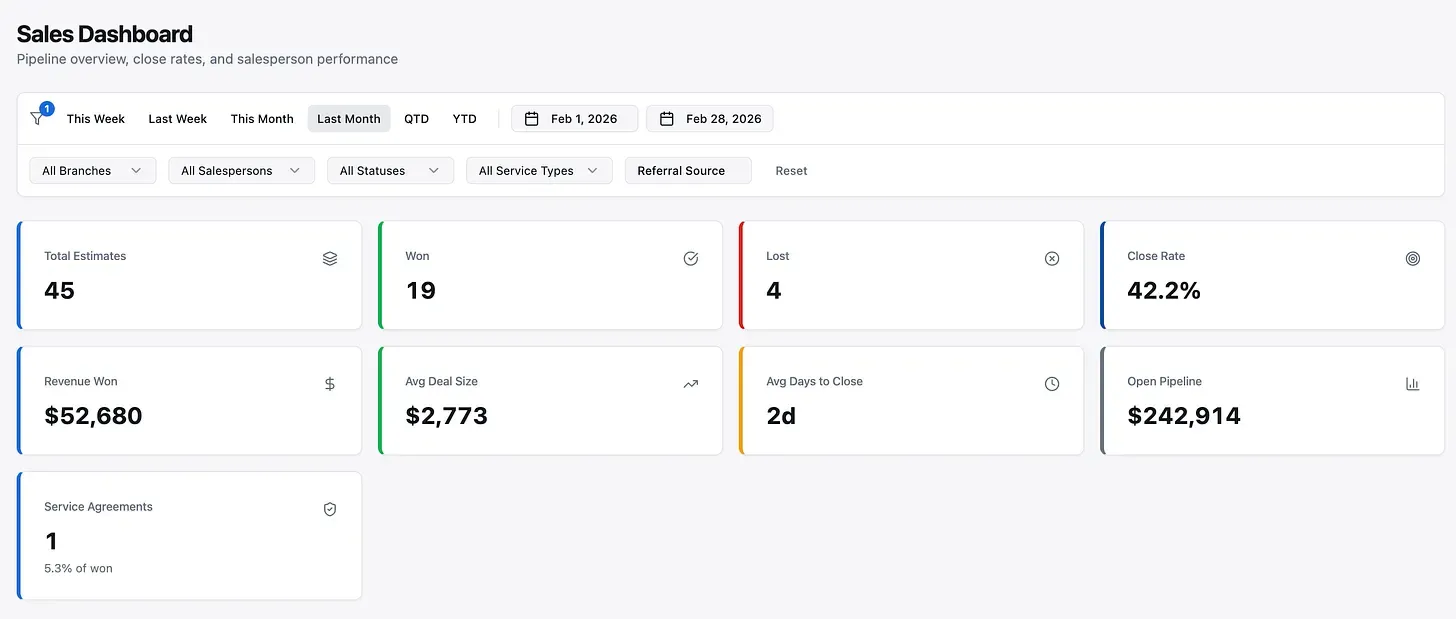
Unpaid and overdue invoices
Cash is the thing that kills small businesses, not profit. The dashboard separates what is simply unpaid from what is genuinely overdue, sorted by age and amount. You chase the right ones first instead of letting them slide.
What to ignore
A dashboard that tracks everything tracks nothing. The fastest way to make one useless is to cram in every metric you can pull.
Skip vanity numbers that look nice and change nothing. Lifetime totals, raw activity counts, and metrics you will never act on are noise. If a number would not change a decision you make this week, it does not belong on the main screen. We can park the extras on a second tab if you want them, but the front page stays clean.
How it works with your tools
You do not switch anything. The dashboard sits on top of the stack you already run.
It pulls from your field service software, your accounting, your booking system, or a plain spreadsheet, whatever holds the data. A workflow gathers everything overnight, does the math, and pushes a clean view to a web page and your inbox. Most of this runs on the same kind of business automation that powers the rest of your back office, so the reporting and the doing share one pipeline.
If you want the deeper story on how these get built, I wrote it up on the blog.
Who it is for
This is for the owner who is the one still pulling the reports. You are past sticky notes and gut feel, but a full analytics team is overkill and a waste of money.
I cut my teeth in the trades, HVAC, plumbing, and cleaning, so service businesses are home base. One shop had 51 stuck jobs and roughly 1,500 invoices a year that nobody had ever looked at as a whole, until it all landed on one screen and the leaks were suddenly obvious. But the model is not trade-specific. Clinics, salons, law offices, shops, and agencies all sit on the same problem. Good data trapped in tools nobody checks. If you run an owner-led business around Wadsworth or greater Akron, this fits.
What it costs to leave it undone
Doing nothing is not free. It just hides the bill.
Every overdue invoice you catch late is cash sitting in someone else’s account. Every losing job you repeat is margin gone. Every Sunday you spend rebuilding a report is time you do not get back. Those add up quietly, month after month, while the spreadsheet keeps telling you things are probably fine.
A clear dashboard turns probably into know. It is the same instinct behind good web design. Make the important thing easy to see and easy to act on.
Get a dashboard that earns its place
Start with the numbers that drive your decisions. Get those right, then build out. Book a call and we will map what should be on your screen and what to leave off.